2026-10-21
How to Handle Emergency HOA Vendor Repairs: A Step-by-Step Guide
Learn how to handle emergency HOA vendor repairs with clear steps on authorization, vendor calls, documentation, and resident communication.
Table of Contents
- Step 1: Identify and Assess the Emergency
- Step 2: Know Your Emergency HOA Repair Authorization Limits
- Step 3: Follow HOA Emergency Maintenance Procedures for Immediate Action
- Step 4: Use an HOA Emergency Vendor Call Script
- Step 5: Vet and Dispatch Qualified Vendors
- Step 6: Communicate with Homeowners, Residents, and Staff
- Step 7: Complete the HOA Emergency Repair Documentation Checklist
- Step 8: Manage the Financial and Insurance Aftermath
- Conclusion
Last Updated: October 20, 2026
Step 1: Identify and Assess the Emergency
Emergency HOA vendor repairs start with any condition that threatens life safety, causes active property damage, or makes a building uninhabitable. In practice, that means you need a clear test, not a gut feeling at 2 a.m.
The fix is a short triage list:
- Life safety first. Fire, gas smell, structural movement, or a person trapped means call 911 before anything else.
- Active damage. Water pouring through a ceiling, sewage backup, or a live electrical hazard.
- Loss of habitability. No heat in freezing weather, no water to the building, or a failed elevator with someone inside.
- Everything else waits for business hours. A flickering hallway light is not an emergency.
Document what you see the moment you arrive. Photos and videos taken in the first ten minutes carry far more weight with insurers than a written description sent the next day.
Step 2: Know Your Emergency HOA Repair Authorization Limits
Emergency HOA repair authorization is the board-approved spending authority that lets a manager or officer call a vendor without a full board vote. Get this in writing before you ever need it.
Most boards handle this with a standing resolution that sets a dollar cap for after-hours work. The resolution should name who can authorize, what the cap is, and what documentation is required afterward. Without it, your property manager either stalls or spends money the board never approved.
A workable structure looks like this:
| Role | Authority | Typical Scope |
|---|---|---|
| On-site staff | Call for emergency service only | No spending authority |
| Property manager | Approve up to a set cap | Water extraction, board-up, lock repair |
| Board president | Approve above manager cap | Structural shoring, major system failure |
| Full board | Anything beyond emergency scope | Replacement, contracts, special assessment |
Warning: The most common mistake is a resolution that sets a cap but never says who can exceed it. When a burst pipe needs a emergency vendor at midnight, staff end up guessing, and guesswork is how boards end up defending unauthorized spending to homeowners.
Check your governing documents for existing authority language before drafting anything new. Your Davis-Stirling compliance obligations and your bylaws both shape what the board can delegate.
Step 3: Follow HOA Emergency Maintenance Procedures for Immediate Action
HOA emergency maintenance procedures should move in a fixed order: protect people, stop the damage, then call the vendor. Skipping the middle step is expensive.
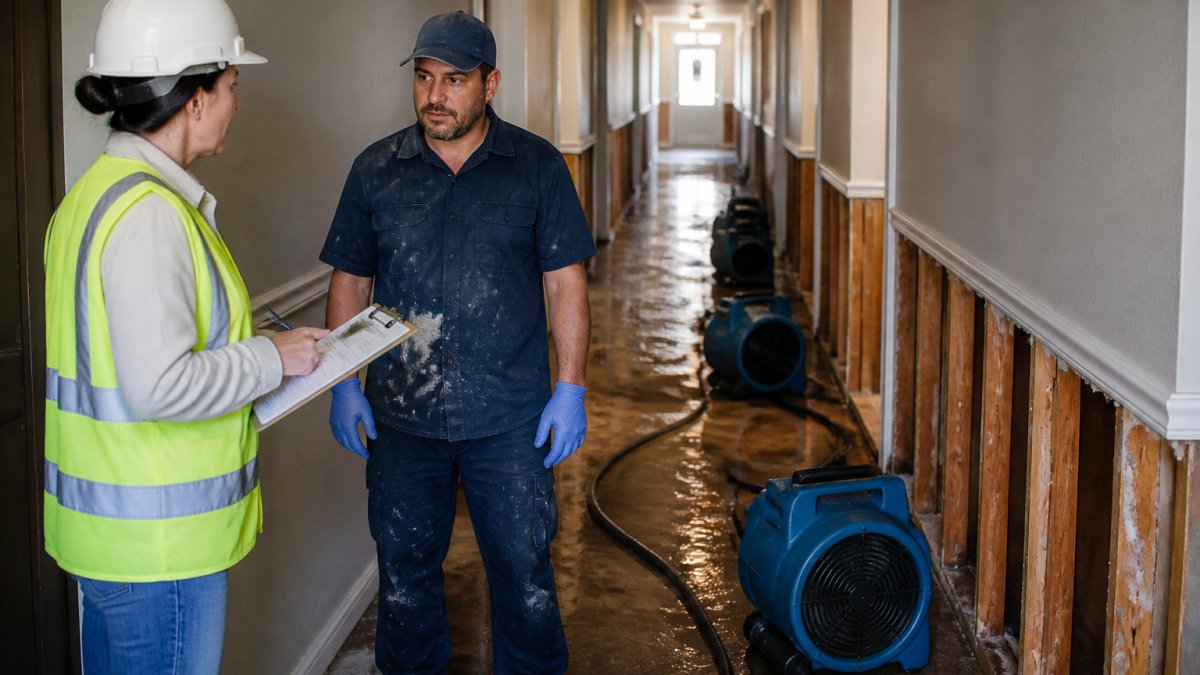
Here is the sequence we recommend boards put on a single laminated card:
- Confirm no one is injured and call 911 if needed.
- Shut off water, gas, or power at the source if it is safe to do so.
- Clear residents from the affected area and post barriers.
- Call the on-call technician or emergency vendor.
- Notify the board president and property manager.
- Start a written log with times, names, and actions.
That log matters more than people expect. It becomes the backbone of the insurance claim, the vendor invoice review, and any later question about whether the board acted reasonably.
Step 4: Use an HOA Emergency Vendor Call Script
An HOA emergency vendor call script is a short set of questions your staff reads from the phone so nothing critical gets missed under pressure. Keep it to one page.
Here is the script we hand to boards:
“This is [name] from [association], at [address]. We have a [type of emergency] affecting [number] units.
- Can you confirm a technician is available tonight, and what is the estimated arrival window?
- What is your after-hours call-out rate and hourly rate?
- Will you send a written scope and estimate before starting work beyond emergency stabilization?
- Who is the on-site contact, and what is their direct number?
- Can you provide a certificate of insurance before dispatch?
- What is your invoice and lien-release process?”
Write down every answer. If a vendor will not answer question five, that is your answer about whether to use them.
Tip: Ask for the technician’s name and cell number, not just the dispatch line. When a crew is on site at 1 a.m., reaching the person actually holding the wrench saves an hour of phone tag.
Step 5: Vet and Dispatch Qualified Vendors
Qualified vendors for emergency HOA vendor repairs are the ones you already vetted before the emergency, not the first name that answers at midnight. Emergency procurement is where boards get burned, because the pressure to act fast is exactly what lets an unlicensed contractor, a conflicted insider, or an opportunistic rate through the door.
Build a short approved vendor list by trade: plumbing, electrical, water extraction, roofing, elevator, and locksmith. For each one, keep a one-page vendor file with:
- Current certificate of insurance naming the association as additional insured, with the expiration date highlighted
- License number, the state or local lookup source used to verify it, and the date of the last verification
- After-hours contact, dispatch line, and the technician’s direct cell number
- Rate sheet or written rate confirmation, including after-hours call-out, hourly, and overtime rates
- Signed service agreement with lien-release terms and a scope-before-work clause
- Two or three references from comparable associations, with the date last checked
Verify, don’t just file
A certificate of insurance in a folder proves nothing if it expired last quarter. Set a recurring calendar reminder to re-verify licenses and insurance at least annually and whenever a policy renews. When you call a vendor out, ask dispatch to email the current certificate before the crew rolls; if they cannot produce it, that is your answer about whether to use them. Confirm the license through the issuing state or local authority rather than trusting the number on the invoice.
Emergency procurement safeguards
A common pattern is to allow single-source dispatch to an approved vendor, with a written scope required before work goes past stabilization. That keeps response fast without handing a blank check to a stranger. Add these safeguards to the policy:
- Two-person rule for large authorizations. Above the manager’s cap, require a second board officer’s verbal approval, logged with time and name.
- Written scope before non-emergency work. Stabilization can start on a phone call; permanent repair needs a scope and estimate.
- No same-day change orders without documentation. If the crew finds more damage, the change must be written and approved under the same authority limits.
- Conflict-of-interest disclosure. Board members and managers should disclose any family or business relationship with a vendor before the vendor is added to the list, and recuse themselves from that approval.
- Price-gouging awareness. During widespread events, demand surges and rates spike. Compare the emergency invoice against the vendor’s filed rate sheet, and flag any line item that exceeds it without a written explanation.
Warning: If a vendor is not on your approved list, treat the emergency call as a temporary fix only. Stabilize, document, and then run the permanent repair through normal competitive bidding. An unknown vendor at 2 a.m. is a stabilization resource, not a procurement decision.
Set service-level expectations before you need them
A contact list is not a plan. For each approved vendor, agree in writing on:
- Response-time target. For life-safety trades, a common target is on-site within one to two hours; for water extraction, within two to four hours. Put the number in the service agreement.
- Arrival and completion tracking. Log dispatch time, arrival time, stabilization time, and completion time on the incident log. Those four timestamps are what you review after the job.
- Escalation triggers. If the vendor misses the response target, the on-call manager escalates to the next approved vendor and notifies the board president.
- Post-job review. Within a week, review the invoice against the rate sheet, confirm the scope was followed, and note whether the vendor stays on the list.takeaway Vetting is a pre-crisis exercise. The emergency is not the time to discover that your plumber’s insurance lapsed or that your board president’s brother-in-law owns the water-extraction company.
Step 6: Communicate with Homeowners, Residents, and Staff
Residents forgive a burst pipe. They do not forgive silence. Communication during an emergency is part of the repair.
Send a short notice through your normal channels as soon as the situation is stable enough to describe. Cover four things:
- What happened
- What is affected and who is displaced
- What the board is doing right now
- When they will hear from you again
Give a specific next-update time and hit it, even if there is nothing new. Silence reads as chaos.
Staff need a different message. Tell them who is in charge, where the shut-offs are, and who they should call. If the property has building staff, they are usually the first responders on scene, so brief them on the emergency contacts list and the call script.
Step 7: Complete the HOA Emergency Repair Documentation Checklist
The HOA emergency repair documentation checklist is what protects the board months later. Assemble it while the details are fresh.
- Photos and videos of the damage before, during, and after repair
- Written incident log with times and names
- Vendor work order and signed scope of work
- Certificate of insurance on file
- Itemized vendor invoice with receipts
- Repair notices sent to residents
- Board ratification of the emergency expenditure at the next meeting
- Insurance claim number and adjuster contact
Ratification is the step boards forget. Even when the emergency spending was authorized, the board should formally ratify it in the minutes so the record shows a clean decision trail.
Step 8: Manage the Financial and Insurance Aftermath
Emergency repair costs come out of the reserve fund or the operating budget, and the board needs to say which. That choice has consequences for next year’s assessments. But before the board decides who pays, it has to answer a harder question: which party is actually responsible for the damaged area?
Determine responsibility before you spend
Most governing documents divide maintenance responsibility between the association and the owner. The dividing line is usually the unit boundary, but the details matter: limited common elements, exclusive-use areas, and utility lines that serve only one unit are common sources of dispute. Before authorizing permanent repair, check the maintenance-and-repair provisions in the declaration and any adopted responsibility matrix. A short written determination, association, owner, or shared, with the document citation keeps the decision defensible.
A practical sequence:
- Identify the affected area and whether it is a common element, limited common element, or unit interior.
- Find the responsibility clause in the governing documents and note the section.
- Check the cause. A failed association pipe is treated differently from an owner’s neglected fixture, even if the damage lands in the same hallway.
- Decide who authorizes the emergency work. The association can usually act to protect common elements and stop damage regardless of ultimate responsibility, then pursue reimbursement.
How master and individual policies interact
The association’s master policy and an owner’s HO-6 policy cover different things, and the gap between them is where boards get surprised. In general terms:
- The master policy typically covers the association’s common elements and the building shell, subject to the deductible and any governing-document allocation.
- An individual owner’s policy typically covers the unit interior, personal property, and any loss assessment charged by the association.
- Deductibles can be allocated to a responsible owner or to all owners depending on the governing documents and state law.
Do not guess at coverage. Ask the association’s insurance agent to confirm in writing which policy responds to the loss and how the deductible will be handled. That written confirmation belongs in the documentation file.
File the claim and protect the record
File the insurance claim promptly and let the adjuster see your documentation package. Photos, the incident log, and itemized invoices do most of the work. Keep repair costs separate from betterment costs, because insurers generally cover the former and not the latter. Track the claim number, adjuster contact, and every communication in the same file as the vendor records.
Fund the gap and plan for the next one
Emergency repair costs come out of the reserve fund or the operating budget, and the board should say which in the minutes. If the reserve fund is used, note the withdrawal and whether it triggers a funding-plan update. If the operating budget absorbs it, check whether a mid-year assessment adjustment is needed.
Then look at the bigger picture. A single emergency is a data point. Three water emergencies in two years is a pattern, and a pattern belongs in your reserve planning. That is where a current reserve study earns its keep. It shows whether the failing component was already scheduled for replacement and whether the funding plan is holding up. Apex Reserve Study builds board-ready reports that connect maintenance history to funding, so the next emergency is a line item rather than a surprise.
Frequently Asked Questions
What counts as an emergency repair in an HOA?
An emergency repair in an HOA is any issue that poses an immediate threat to life safety, health, or property, such as a burst pipe flooding common areas, a roof leak during a storm, a sewage backup, or a broken elevator trapping residents. It also includes failures that could cause rapid secondary damage if not addressed quickly. Routine maintenance like repainting or landscaping is not an emergency. When in doubt, ask whether waiting 24 hours would make the damage significantly worse or endanger residents.
Who can authorize emergency repairs for an HOA?
Typically, the board president, a designated board member, or the property manager can authorize emergency repairs, depending on your governing documents. Many boards adopt a written policy specifying who has authority and up to what dollar limit. For emergency HOA repair authorization, the key is to have a clear chain of command so vendors aren't waiting for approval while damage spreads. After the repair, the board should ratify the decision at the next meeting to keep the process transparent and documented.
What should an HOA do if an emergency repair exceeds the board's spending limit?
If the repair cost exceeds the board's authorized spending limit, the board should still act to prevent further damage, then document why the emergency required immediate action. Many states allow boards to exceed normal limits in a true emergency, but you must follow your governing documents. Contact your property manager or legal counsel as soon as possible. Afterward, disclose the expense to homeowners and, if needed, discuss funding options like reserve funds or a special assessment at the next board meeting.
Emergencies expose whether your authority, vendor list, and documentation were ready before the phone rang. If your reserve funding plan has not been reviewed since the last major repair, that gap is worth closing now. Get a quote from Apex Reserve Study and see how a clear funding plan reduces the odds that the next emergency turns into a special assessment.
Need a Reserve Study?
Get a free quote for your California HOA or condo association. We respond within 1 business day.
Get Your Free Quote