2026-10-28
How to Understand HOA Liability for Balcony Structural Failures
Know your HOA balcony liability when structural failures happen. Learn who is responsible and how reserve studies prevent costly repairs.
Last Updated: October 27, 2026
Quick Summary
HOA balcony liability after a collapse usually falls on more than one party: the association, the board, the unit owner, and sometimes a contractor can all share fault. Whoever had a duty to maintain the structure and failed that duty carries the most exposure, and that duty is defined in your governing documents.
- If a balcony is a limited common element, the association usually handles structural repairs while the owner handles cleaning and surface upkeep.
- Most association policies exclude long-term wear, rot, and corrosion, so the association often pays for the repair itself.
- Restrict access to the affected balcony immediately and post a written notice, sending a copy to the owner.
- Photograph the defect before any repair, because the condition as found is evidence if a claim follows.
- Keep a single defect log recording every reported concern, inspection, and repair as proof of reasonable care.
Table of Contents
- Who Is Liable After a Balcony Collapse?
- HOA Balcony Responsibility: What Governing Documents Actually Say
- Premises Liability and Negligence: The Legal Framework
- Common Causes of Balcony and Deck Structural Failure
- Signs of Structural Damage in Balconies Every Board Should Recognize
- Balcony Structural Inspection Requirements for HOAs
- The Board’s Decision-Making Workflow After a Suspected Defect
- Insurance Coverage, Exclusions, and Claims Coordination
- HOA Reserve Study Balcony Repairs: Funding Long-Term Safety
- Request a Reserve Study Quote to Protect Your Community
Who Is Liable After a Balcony Collapse?
HOA balcony liability after a collapse usually lands on more than one party. The homeowners association, the board of directors, the unit owner, and sometimes a contractor can all share fault. Understanding HOA balcony liability starts with one fact: whoever had a duty to maintain the structure and failed that duty carries the most exposure.
This guide breaks down how that duty gets assigned. The answer almost always lives in the governing documents, not in guesswork.
Below is an overview of the legal framework, warning signs, and a decision workflow.
HOA Balcony Responsibility: What Governing Documents Actually Say
HOA balcony responsibility depends on how your CC&Rs, bylaws, and plat map divide the property. These documents define what the association owns, what owners own, and who pays for repairs. Read them before you assume anything.
Common Elements vs. Exclusive Use Areas
That distinction matters. If a balcony is a limited common element, the association usually handles structural repairs while the owner handles cleaning and surface upkeep. Get this wrong and you may bill the wrong party for a repair.
How CC&Rs Allocate Maintenance and Repair Duties
Watch out: some older documents are silent on balconies entirely. In that case, boards should get a legal opinion before assigning costs. Guessing creates disputes you do not need.
Premises Liability and Negligence: The Legal Framework
Premises liability is the legal principle that holds a property owner responsible for injuries caused by unsafe conditions on the property. Negligence adds a second layer: did the responsible party fail to act with reasonable care?
Common Causes of Balcony and Deck Structural Failure
Structural failure rarely happens without warning. The causes are usually visible years before a collapse, which is why routine inspection matters so much.
Structural Deterioration, Wood Rot, and Corrosion
Water is the enemy. Wood rot sets in where moisture collects at the ledger board and joist connections. Corrosion eats at steel and rebar once water reaches it. Both weaken the structure slowly and quietly.
Overloading and Insufficient Reinforcement
A common mistake is assuming a balcony that “looks fine” is safe. Rot and corrosion hide behind stucco and paint.
Signs of Structural Damage in Balconies Every Board Should Recognize
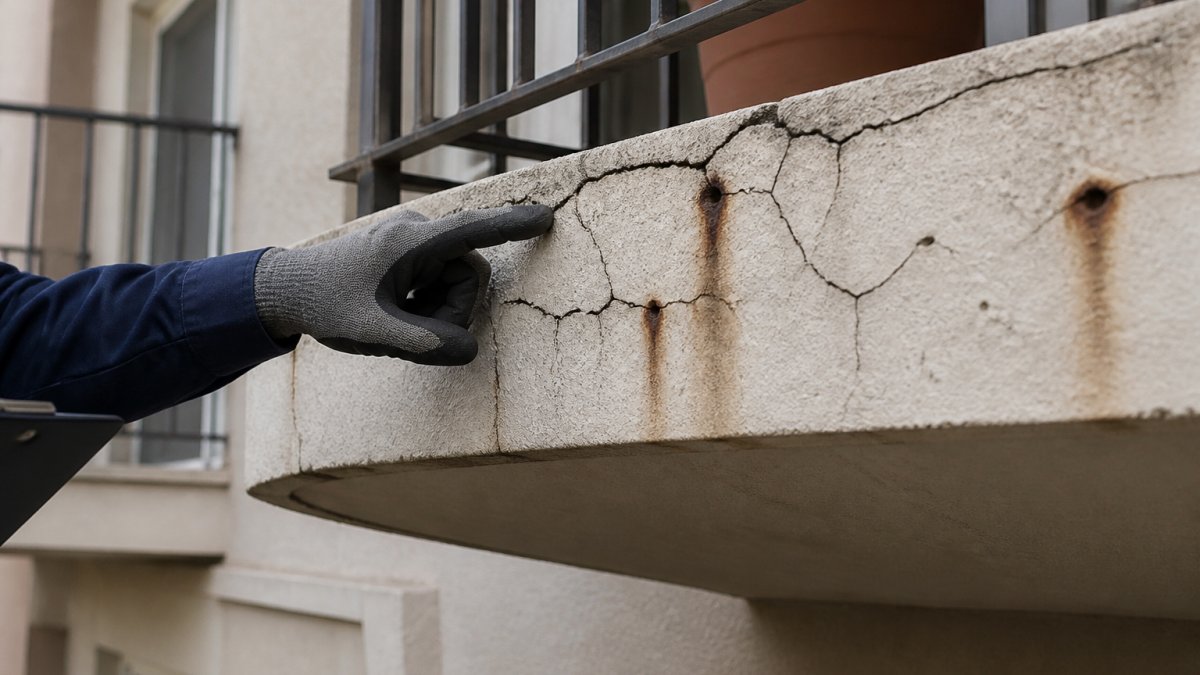
Look for these red flags:
- Cracks in concrete slabs or railings
- Sagging or deflection in the deck surface
- Rust stains or corrosion at connections
- Railing that wobbles or feels loose
- Soft wood around the ledger board
- Water pooling or poor drainage
If your board is starting from zero, a structured first pass helps. Our guide on how to conduct an initial balcony safety audit walks through the steps.
Balcony Structural Inspection Requirements for HOAs
Boards in California should know their specific obligations. Our guide to SB 326 balcony inspection rules for California HOAs covers inspection cycles, qualified inspectors, and compliance deadlines. For budgeting, our breakdown of the cost of an SB 326 balcony inspection shows what boards should plan for.
What to Expect From a Structural Engineer Inspection
A structural engineer inspects load-bearing elements, connections, and the building envelope. Expect a written report with findings, photos, and repair recommendations. Keep that report with your inspection records. It becomes key evidence if a claim arises.
The Board’s Decision-Making Workflow After a Suspected Defect
| Step | Action | Who Leads | Record Produced |
|---|---|---|---|
| 1 | Restrict access to the affected balcony | Board president | Written access-restriction notice |
| 2 | Document the condition with photos, measurements, and notes | Property manager | Dated photo log and condition report |
| 3 | Notify the affected owner and adjacent residents in writing | Board secretary | Copy of notice with delivery date |
| 4 | Engage a licensed structural engineer for inspection | Board vote | Engagement letter and inspection report |
| 5 | Review findings and enter them into board minutes | Full board | Minutes with findings and vote |
| 6 | Decide on repair scope, funding source, and timeline | Full board | Resolution with budget authorization |
| 7 | Communicate the plan and schedule to all residents | Board president | Resident notice and FAQ |
Step 1: Restrict Access Immediately
Move fast on step one. An access restriction protects people and shows the board acted on an immediate threat. Post a written notice at the balcony door, send a copy to the owner, and log the date and time. Do not rely on a phone call. If the balcony is reachable from a common area, consider temporary barriers or signage at the building level as well.
Step 2: Document the Condition Before Anything Changes
Photograph the defect from multiple angles, including close-ups of cracks, rust stains, and connection points. Note the date, the observer, and the exact location. Do not repair or alter the condition before the engineer inspects it unless there is an immediate danger. Preservation matters: if a claim or lawsuit follows, the condition as found is evidence.
Warning: Do not let a contractor make temporary repairs without photographing the original condition first. Altering the scene can weaken the association’s ability to show what it knew and when.
Step 3: Notify the Owner and Residents in Writing
The notice should state the access restriction, the reason, the expected inspection date, and a contact for questions. Keep a copy with the delivery method and date. For residents in adjacent units, a short notice that an inspection is scheduled and that no action is required on their part prevents rumors.
Step 4: Hire a Qualified Inspector
The board should authorize the engagement by vote and confirm the inspector’s license and scope in writing. A general contractor’s walkthrough is not the same as a structural engineer’s inspection. If state or local rules require a licensed engineer, a handyman’s sign-off will not satisfy them.
Step 5: Log Findings in the Minutes
Enter the inspection findings, the engineer’s recommendations, and the board’s vote into the minutes. Minutes are the association’s memory. A board that can show a dated finding followed by a dated decision is in a far stronger position than one that cannot.
Step 6: Decide Scope and Funding
The board should decide the repair scope, the funding source (reserve, special assessment, or insurance proceeds), and a target timeline. Record the vote and the reasoning. If the repair is large, consider a second engineer review or a bid process.
Step 7: Communicate the Plan
Tell residents what will happen, when, and what it costs them, if anything. A short FAQ reduces calls and shows the board is managing the issue. Update residents when the schedule changes.
Keep a Defect Log
Open a single defect log for the building and record every reported concern, inspection, and repair. The log should include the date reported, the location, the observer, the action taken, and the closure date. This log becomes the association’s proof of reasonable care if a claim arrives years later.
Insurance Coverage, Exclusions, and Claims Coordination
Insurance rarely covers everything boards assume it does. Most association policies exclude long-term wear, rot, and corrosion. Those are maintenance failures, and insurers treat them as the board’s problem. Understanding the layers before a claim happens is what separates a smooth recovery from a dispute.
The Layers of Coverage
A balcony failure can touch several policies at once:
- Association property policy, covers the building and common elements, subject to deductibles and exclusions.
- Association general liability policy, responds to bodily injury and property damage claims against the association.
- Directors and officers (D&O) policy, may respond to claims against board members for decisions made in their official capacity.
- Unit-owner HO-6 policy, typically covers the owner’s personal property and interior improvements, and may include loss assessment coverage for special assessments.
- Contractor policies, if a contractor’s work caused or contributed to the failure, its general liability policy may be in play.
Common Exclusions to Expect
Most property policies exclude damage from wear and tear, deterioration, rot, corrosion, and inadequate maintenance. Some policies exclude faulty workmanship. The practical effect is that the association often pays for the repair itself and looks to liability coverage only for injury claims. Read the exclusions before you assume a repair is covered.
Tip: Ask your insurance agent for a written summary of what the policy excludes for balcony and elevated-element claims. Keep that summary with your inspection records.
Claims Coordination After a Failure
When a claim happens, coordinate early. Notify your carrier promptly and follow the notice requirements in the policy. Preserve evidence: do not discard damaged components before the carrier or its adjuster has seen them. Keep repair records, inspection reports, and board minutes intact. If an owner files a claim under their HO-6 policy, the association may need to cooperate with the owner’s carrier.
How the Policies Interact
Our article on how the California insurance crisis impacts HOA reserve planning explains how coverage pressure is reshaping board budgets.
HOA Reserve Study Balcony Repairs: Funding Long-Term Safety
A clear funding plan also reduces personal liability for board members. Readers can learn what a structural integrity reserve study covers and how it differs from a standard study. It shows you planned, not ignored.
Request a Reserve Study Quote to Protect Your Community
At Apex Reserve Study, we provide professional reserve studies tailored for California condo associations and property managers. Our reports are 100% Davis-Stirling compliant and board-ready. We respond to quote requests within one business day and work on fixed timelines with no surprises. We offer integrated SB 326/721 elevated-element planning.
Get a quote from Apex Reserve Study.
Frequently Asked Questions
Who is liable when a condo balcony collapses?
Liability questions can involve governing documents and maintenance responsibilities. Consult a qualified California attorney for advice about a specific situation.
Is a condo balcony the HOA's responsibility or the unit owner's?
Responsibility depends on the governing documents and applicable law. Review the documents and consult a qualified California attorney when the allocation is unclear.
What should an HOA do after discovering structural damage to a balcony?
For a specific safety concern, consult qualified professionals and review the association's governing documents and applicable requirements. A reserve study can help communities plan for long-term maintenance funding.
How often should condo balconies be inspected?
Inspection requirements depend on applicable law and the building. Consult the relevant authorities and qualified professionals about requirements for a specific property.
The work starts with one step. Reach out for a quote and let us show you what a predictable, transparent reserve study process looks like for your association.
Need a Reserve Study?
Get a free quote for your California HOA or condo association. We respond within 1 business day.
Get Your Free Quote